Monday, June 11, 2018

The 2018 FAFSA Deadline Is Approaching

Submissions for the Free Application for Federal Student Aid are due June 30. If you want to access grants scholarships, federal student loans or a work-study opportunity, you have around two and half weeks to fill out the FAFSA to qualify (Remember, for federal aid, you have until June 30 after the school year to…

Read more...

Via Finance http://www.rssmix.com/

How To Make Lots Of Money During The Next Downturn

How to make lots of money during the next downturnDuring the last downturn, I lost about 35% of my net worth. I don’t plan on doing that again.

Losing 35% is not as bad as the S&P 500 losing ~60% during its worst period, but it still hurt like hell due to the speed and absolute dollar amount of the loss.

Realistically, my target scenario during a recession is to stay flat – neither make nor lose money. But my blue sky scenario is to actually try and make lots of money as the world collapses all around.

Here’s how I plan to do it and how you might too. 

How To Make Money During The Next Downturn

1) Be OK with no longer making money.

The first step to making money during the next downturn is to be OK no longer making money during an upturn. In other words, you must methodically sell off risk assets like stocks and real estate the longer we go in the cycle.

It hurts to miss out on gains, but missing out on gains is the only way to not lose money. Your goal is to time your asset allocation so that you have the least amount of risk exposure when the cycle turns. The problem, obviously, is that nobody knows when the cycle will turn.

To get a better idea of where we are in the cycle, it’s important to study history and make an educated guess.

Bull markets last on average about 97 months (8 years) each and gain an average of 440 points in the Standard & Poor’s 500 stock index. By comparison bear markets since the 1930s have an average duration of only 18 months (1.5 years) and an average loss in value of about 40 percent.

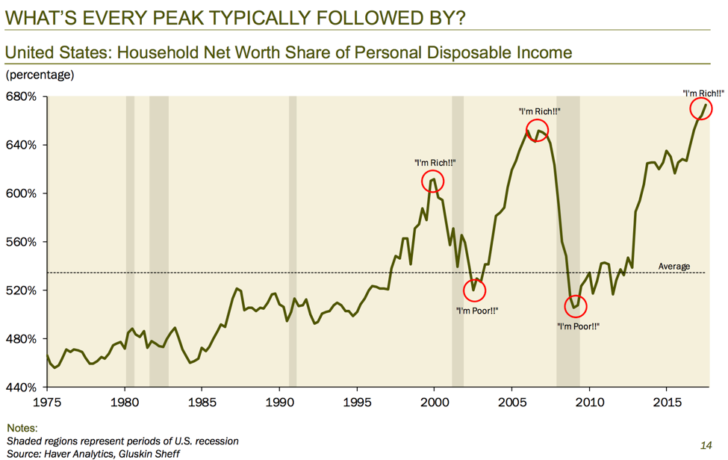
If we are to say the recovery began in 2010, then 2018 is the 9th year of the current cycle. With the Fed starting to tighten, valuations close to all-time highs, and earnings growth slowing down, we can conclude that it’s logical to start taking some risk off the table.
Related: How Much Investment Risk To Take In Retirement

2) Be at least neutral when the cycle turns. 

It seems likely there will be a recession before the end of 2020 (11-year cycle). Therefore, you want to move mostly to cash and CDs before then or have short positions that outweigh your long positions at the very end of the cycle.

Remember, even if you move to 100% cash or CDs, you are still going to make a guaranteed ~3% on your money each year based on today’s risk-free rate. You must weigh your guaranteed return against the possibility of missing out on further gains or the possibility of losing money.

If you have already made over a 200% return in the stock market since 2010, is it so bad to only make 3% a year instead of 8% a year if you have to take more risk? If your property equity is up 500% since 2012, do you really want to pay three more years of property tax, mortgage, and maintenance expenses if prices might stay flat or go down 20%? These are some of the questions you should ask yourself.

See: Always Calculate Opportunity Cost When Making A Major Investment

3) Take some risk and go net short. 

The only way to make a lot of money in a downturn is to take risk. This means losing money if the downturn never comes.

The easiest way to short risk is to buy an ETF that goes up when the underlying index it tracks goes down. Here’s a list from ProShares which includes leveraged short and long ETFs to really juice your returns or blow yourself up.
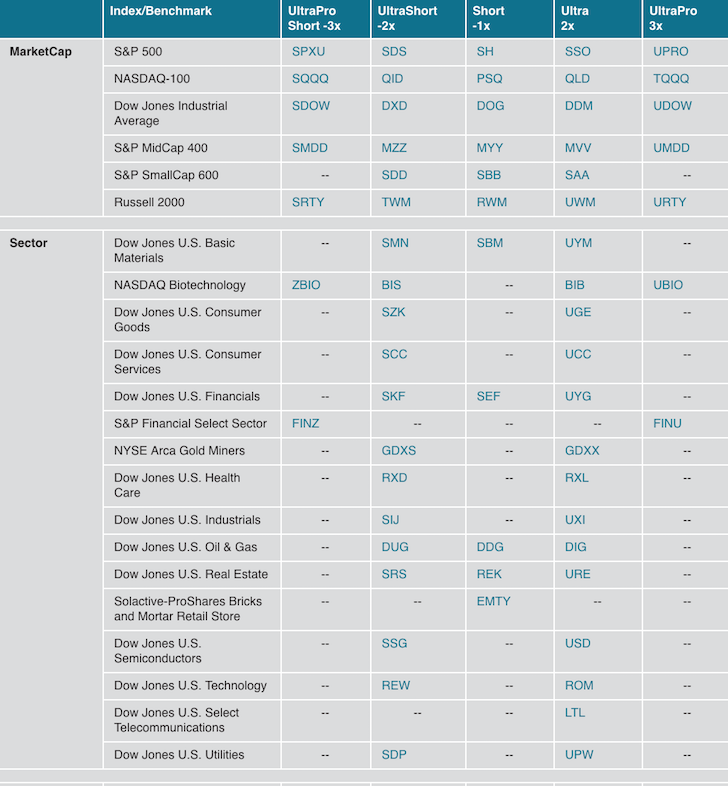
A list of short ETFs

You can also short individual stocks as well if you feel you have an edge and want more direct exposure. The stocks that usually get hammered the most during a downturn are high beta stocks with weak balance sheets and no earnings.

In other words, small cap names in the biotech and tech sectors often go down the most because their valuations are all based on speculative terminal values. Such companies will be relentlessly attacked on the short side as speculation grows they will go out of business. If you’re a loss making company with no moat, you will die if the downturn lasts long enough because the capital markets will be shut to any fundraising. This is why shorting the Russell 200 small cap index (TWM) is quite popular in a bear market.

On the other hand, cash-rich, mega capitalization companies that have a long history of paying a dividend tend to go down the least. Think about names in the utilities space and consumer staples space like AT&T or Proctor & Gamble. They are not only highly profitable, but also have enough cash to last them through years of unprofitability. Thus, given we know the average recession lasts only 18 months, many investors seek relative safety by buying utility or consumer staple stocks.

Beware, if you short a high dividend yielding sector or stock or treasury bond ETF, you will be forced to pay that dividend.

Related: The Proper Asset Allocation Of Stocks And Bonds By Age

Go Long Volatility

You can also go long volatility by buying a volatility ETF such as VXX. During the early 2018, 10% sell-off in the S&P 500, the VXX doubled from $25.68 to $50. Just beware that going long volatility for the long term is a losing proposition due to a thing called “decay.”

The chart below is a 5-year history of the VXX. Notice how the price was $1,090 back on August 1, 2013. Today it’s only at $33 for a 97% loss! In other words, you can only go long volatility for brief periods of time (less than a couple of months) before the structure of the investment drags you down.
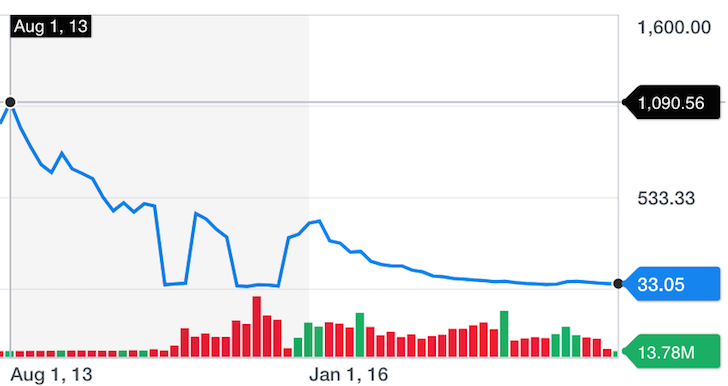
VXX Volatility 5-Year Chart

Go Long US Treasuries

When the world is collapsing, investors tend to seek the safety of US Treasury bonds. Two of the most common ETFs to buy are IEF (iShares 7+ Year Treasuries) and TLT (iShares 20+ Year Treasuries). Buying TLT will give you more upside and volatility given longer duration bonds are more sensitive to interest rate changes.

Notice how TLT spiked from $92.83 on Oct 1, 2008 to $119.35 on Dec 1, 2008 (+28.6%) during the depths of the financial crisis. There have been several more 20%+ trading opportunities since 2008 due to geopolitical risk, policy risk, and further stock market sell-offs.

It’s interesting to note that even if you had bought TLT at its high during the crisis, you’re back to even today while earning a steady ~3% annual yield.
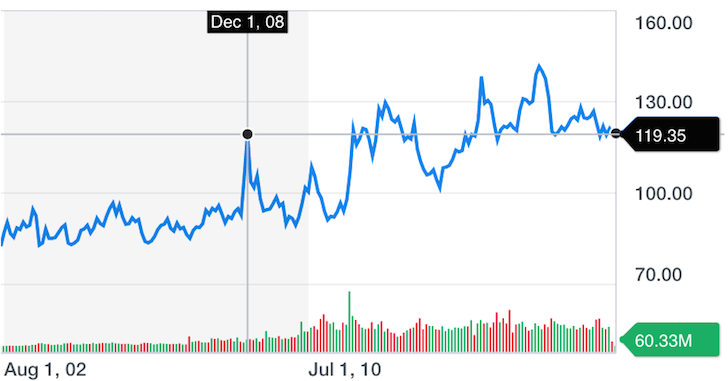
LTL 20+ US Treasury Long Bond Historical Chart

Related: The Case For Buying Bonds: Living For Free And Other Benefits

Go Long Gold

Gold is a hard asset that also tends to do well during a downturn. Even though gold generates no earnings and provides no dividends, it’s a commodity that can be traded. The more dire the economic situation, the more valuable hard assets become.

The largest, most popular gold ETF is GLD, followed by IAU. As you can see from the GLD historical chart below, it did phenomenally well from Oct 1, 2008 up until early 2012 (+170%) before fading as the bull market took off.
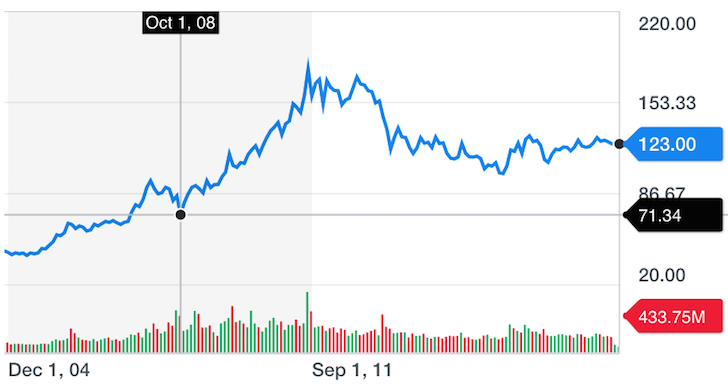
GLD Gold Historical Chart

If you invest in gold for the long-term, it’s important to understand global demand and supply dynamics, and take a view on the US dollar since gold is denominated in US dollars. Gold is an imperfect hedge.

Go Long Yourself

The people who don’t lose their jobs in a recession are those who are too valuable to their firms. Therefore, build enough skills, client relationships, and internal goodwill to be forever employed. You are likely your largest money maker.

Going to business school part-time was one of my best money makers because not only did I build new skills, my firm felt they had invested too much in me by paying 85% of my tuition to just let me go. They wanted their three years of indentured servitude in return for tuition assistance.

Besides getting more formal education, you should put some time aside each week to exercise your creative mind. Maybe you’ll write a counter-cyclical book, or come up with a song that earns royalties, or start a website that earns advertising revenue about your favorite hobby. These extra engines could blast you off into financial space.

Thanks to Financial Samurai, my overall net worth has outperformed the S&P 500 and San Francisco real estate since it began in 2009.

The Easiest Way To Make Money In A Downturn

Shorting the market long term is a losing proposition due to population growth, ever-growing demand, dwindling supply, and inflation. It’s the same concept as renting long term.

If you want to short the market, you must be disciplined to short for only a short duration of time. It could be only one week if you are buying volatility or at most two years if you are shorting the S&P 500. During this shorting time period, you will likely lose money as your timing will be imprecise.

As a result, many investors looking to hedge against a downturn build a portfolio of longs and shorts and rebalance their net exposure whenever they feel more bullish or bearish. But in such a scenario, you might lose on your longs and shorts as well.

Given you can mistime the market in both directions and none of the investments above are perfect hedges, the easiest way to make money during a downturn is to go long cash or cash equivalents like CDs. Making a 3% guaranteed return while risks assets go down 30% feels just as good as making a 37% return when your peers are only up 4%.

If you can concurrently build outside income sources while you de-risk, then all the better.

For those of you who are under 40 or who have at least 20 years of work left in you, you might as well keep taking risk based on a more traditional asset allocation model. Long term, investments such as the S&P 500 and real estate tend to go up and to the right. When you combine not spending money with long-term compounding, you will get rich beyond expectations.

For those of you who have enough money to be happy, taking excess risk is unnecessary. Once you’ve made your money, the key is to keep it.

My plan is to continue de-risking until I have no more than 30% of my net worth in risk assets by 2020. Sounds conservative, but I can happily live off 3% a year without ever touching principle.

Related: It Feels A Lot Like 2007 Again: Reflecting On The Previous Peak

Readers, what are some ways you plan to make money during the next downturn? When do you think that next downturn will be?

The post How To Make Lots Of Money During The Next Downturn appeared first on Financial Samurai.

Via Finance http://www.rssmix.com/

Thursday, June 7, 2018

What's Something Frugal You've Done That Backfired?

The summer between my sophomore and junior year of college, I had an internship with the Michigan senate in Lansing. As the position wasn’t paid at first (I eventually convinced them I needed money to, well, live), I stayed in friends’ spare bedrooms throughout the summer, and picked up a second internship at a PR…

Read more...

Via Finance http://www.rssmix.com/

What If You Take A Leap Of Faith And Your Dreams Don’t Come True

What if you take a leap of faith and your dreams don't come true?Leaving a boring job to do your own thing is scary. There’s nowhere to hide when you’re responsible for everything. At the same time, there’s nothing more rewarding than creating something from nothing. No promotion or raise comes close.

Recently, a reader asked, “What do you think you’d be doing now if FS hadn’t worked out so well for you? Back to the IB grind, real estate tycoon, build a tennis school…other? Might be an interesting article unto itself, I know you’d get at least one interested reader.”

I haven’t thought about this situation since 2012, when I first left my day job. Further, I know that after writing, “Career Or Family: You Only Need To Sacrifice At Most 5 Years Of Your Life,” I definitely won’t be going back to work until 2022, at the earliest.

But this is a good thought experiment to ponder because I’m sure many of you might be wondering what if you took the leap of faith and things don’t work out either. 

A Time Limit On Your Crazy Idea

You’ve got about three years to gain traction in your business before society writes you off. Nobody will bat an eye if you disappear for one or two years because plenty of eager beavers go off to business school for two years and re-enter the workforce with no problem.

But after three years, people will start wondering what you were doing with all that time. They’ll start questioning your judgement. They’ll wonder whether you were too delusional or too stubborn to realize that your endeavor wasn’t working out. Once they think all these things, your chances of getting hired at a comparable job you left for comparable pay diminishes precipitously.

Two or three years is also a perfect amount of time for a rational entrepreneur to decide whether his or her product can generate a minimum livable income stream. During this time period, you can probably pivot one or two times as well.

If you aren’t generating a livable income stream after 36 months, or you haven’t raised capital from outside investors, then you should probably get a job.

My Entrepreneurial Time Limit Was Two Years

According to FINRA regulations, the Series 7 license expires after an employment lapse of two years. The test is six hours long and contains 260 questions and there was no way I was taking that puppy again if I decided to rejoin the financial services industry!

Therefore, I gave myself two years to see if I could generate momentum on Financial Samurai. I published three times a week and saw progress. During this two year period I hedged my bets by going on interviews with several financial firms, but I just didn’t feel the same excitement as I did in my 20s. Instead, my excitement was 100% targeted towards my online business.

It was a scary moment to let my Series 7 license expire in June 2014, but it also allowed me to burn my boat and never look back.

If you plan to take a leap of faith, check any license expirations and set a three year time limit, whichever comes first before you go back to work. To help your cause, consider freelancing in your old industry to stay relevant just in case.

Scenarios If Financial Samurai Failed

It’s pretty easy to see a scenario where Financial Samurai would have stayed stagnant or disappeared. I could have lost my motivation to publish consistently each week. Search engines like Google may have never decided to rank my content. And larger media publications may have never decided to highlight my work.

If I couldn’t gain momentum after two years, I would have done the following in order of likelihood:

1) Return to investment banking at age 37 (2014). Instead of working at a bulge bracket firm, I would have elected to work at a boutique bank with better hours and less stress. I would keep Financial Samurai as a secret side hustle and experiment with new content and partnerships.

There is also no chance I would have sold my Marina rental home in 2017 because I wouldn’t have bought another home in 2014. With a sluggish business and a new job, I wouldn’t have the confidence to get further into debt.

After three years of aggressively saving most of my salary and bonuses, I would reassess life and likely try to leave the business again at 40 (2017). With three more years of content, I’m confident Financial Samurai would have been able to generate a livable income stream by then.

2) Move to Honolulu and say to hell with it by age 38 (2015). My wife and I meticulously planned a simple lifestyle of living off ~$100,000 in Hawaii based on our passive income and online income at the time. We would have probably moved in with my parents for several months and then rented a decent two bedroom for $2,000 a month close by.

I would continue to write on Financial Samurai and probably focus more on lifestyle, travel, entrepreneurship and minimalism. We’d probably also do some online freelance work as well.

The amazing thing about Hawaii is that our favorite activities, going to the beach and hiking, are both free. It doesn’t cost much to live there once your housing costs are taken care of.

With no job and a lackluster lifestyle business, I would be highly tempted to sell my primary residence before moving to Hawaii. If I did, I probably would have given up $400,000 – $500,000 in gains.

3) Get a job at a financial technology company. The fintech space has gained tremendous momentum since 2012. I ended up consulting part-time with firms like Personal Capital and Motif Investing for two years. It was a lot of fun understanding the industry, meeting new people, and learning/advising a lot about online marketing. The only downside with fintech is its much lower base pay. We’re talking 40% less in salary than I used to make.

After at most four years of working in fintech, I’d want to leave and move to Hawaii. Four years is how long it takes for shares to vest at most startups. One of my goals at the fintech startup would be to learn about digital marketing to help build Financial Samurai further.

Finding Constant Themes

Going through this thought exercise, I realize that I would still publish on Financial Samurai no matter what. I’ve always used this site as a creative outlet. It’s the perfect thing to do for an early retiree who loves to travel or someone bored with his or her dayjob. Money is a byproduct of doing what I enjoy.

I’m pretty sure I would try and negotiate a severance at whatever job I was working at by the end of 2017 because I’ve always had a goal to leave work by 40. After all, I strongly believe it’s much better to retire by a certain age than by a certain financial figure. As a 40 year old now, I feel more strongly that the older you get, the more you cherish the remaining time you have left.

Trading time for money in your 20s and 30s is easy. But after 40, it starts feeling like a waste since you realize there are plenty of people who pass away in their 40s and 50s. Steve Jobs died at 56 for goodness sake, and he was the healthiest eater with the best healthcare money could by.

Maybe this whole exercise is pointless though, because I’ve always had confidence Financial Samurai would not fail. It costs less than $5,000 a year to keep the lights on. I knew if I could speak forever, I could write forever. The greatest thing about running an online business is that the harder you try, the better you’ll do. I’m not sure if that’s the case with other businesses.

If You Plan To Go Out On Your Own

There is no doubt that being an entrepreneur is stressful, especially if you have a family to raise. Here are some suggestions I have before you go out on your own:

1) Work on your business after hours while you still have a job. Unless you have a major amount of funding, please don’t leave your job to work on your business full-time without testing it out for at least a year. We all know that most businesses fail. Working from 5am – 7am or 9pm – midnight is plenty of time to see if your business can gain traction.

2) Refinance or get a mortgage before you leave your day job. Once you lose your W2 income, you are deemed too risky for banks. Only after you have at least two years worth of 1099 (freelance) income will banks consider you a creditworthy candidate. Despite having a significant amount of assets, one of my refinance attempts got rejected in my early years post work.

3) Leave your day job after you see hockey stick growth or operating profits. If you plan to run a lifestyle business, then it’s best your lifestyle business generates at least a minimal livable income stream before leaving. If you plan to grow a non-lifestyle business, then wait until you see explosive growth and a visible path to profitability before leaving.

4) Negotiate a severance. A severance will buy you months, if not years of runway to grow your business without overly worrying about profits. Once a business focuses too much on profits, the product or user experience generally declines, and so does the overall business. If you can’t negotiate a severance, then have at least one year’s worth of living expenses in the bank, preferably two.

5) Learn the pitfalls and build a network. Speak to as many people in your field of business as possible and learn how they got off the ground and thrived. Learn about their mistakes and figure out ways to help them so that they might one day help you. Listen to as many podcasts and read as many articles as possible about existing entrepreneurs.

6) If you have a spouse, talk things out thoroughly. If you have a spouse, discuss your entire entrepreneurial plan with him or her. Having a spouse work a stable job with benefits while you go off and do your crazy thing is an excellent combination. Just make sure you have some revenue and time guidelines in order to not burn each other out.

The leap will be scary, but the regret of never leaping will eat you up inside if you have a good business idea. Limit your entrepreneurial endeavors to three years and you’ll likely be fine. After three years, all bets are off.

Related:

The 10 Best Reasons To Start An Online Business

Why Blogging Is The Best Business In The World

Readers, any of you thinking about leaving your day jobs to do something entrepreneurial? Existing entrepreneurs, what are some things you wish you did before working on your business full-time?

The post What If You Take A Leap Of Faith And Your Dreams Don’t Come True appeared first on Financial Samurai.

Via Finance http://www.rssmix.com/

Tuesday, June 5, 2018

How To Copyright A Song And Earn Royalties: Introducing Cutie Baby

How to Change Your 'Poverty Mentality' About Money

When it comes to money, we’re all working from a few negative scripts that can hinder our finances. And while going off-script is hard, it is possible. That’s what we’re discussing this week.

Read more...

Via Finance http://www.rssmix.com/